

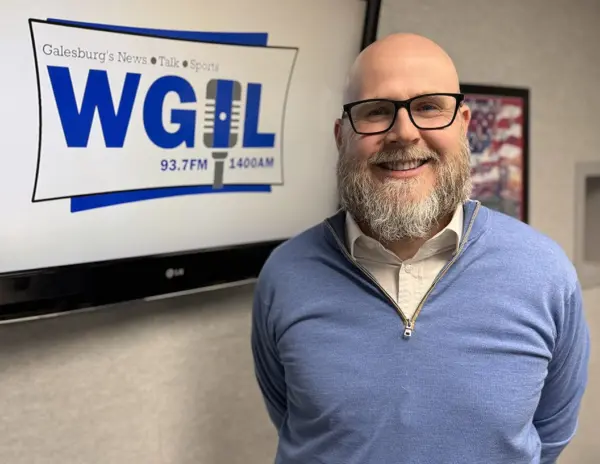
Galesburg District 205 Superintendent of Schools John Asplund says the district ended 2025 in strong shape and is positioned for continued improvement in 2026, despite uncertainty in state and federal funding.
In an interview Tuesday on Galesburg’s Morning News, Asplund addressed a recent social media incident involving “very strange” statements on a TikTok page referencing the return to school. He described the posts as not a direct threat but cause for concern. The district immediately contacted police, who are investigating, and added extra police presence Tuesday at the Junior/Senior High School as a precaution.
Asplund said the decision to keep schools open was based on no credible threat existing. “If every time somebody puts something up on the internet we cancel school, we’re not in school anymore,” he said. “We have to evaluate every situation on its merits.”
Strategic plan and ‘Portrait of a Graduate’
The district is in the middle of a five-year strategic plan centered on the “Portrait of a Graduate,” which emphasizes communication skills, citizenship and a sense of self through clubs and activities.
Curricular shifts: Hands-on learning and technology
One curricular highlight is the PK-4 Bridges Math program, which uses hands-on activities to make math more concrete for young learners. Asplund said the program moves math “from the abstract to the concrete.” “If you don’t understand what 2 plus 2 is like actually 2 plus 2… it doesn’t make it as real,” he said. Internal data shows “really improved” results over the last two to three years.
The district is also reducing reliance on one-to-one technology in lower grades, pushing the device program start from grade 3 up to grade 7 and considering grade 9 or 10 next. Asplund called the original “need to learn computers” argument obsolete, noting it’s a “contradictory message” to ban personal phones while requiring students to sit in front of a larger screen. He added the program is expensive and the district prioritizes people over devices.
Near-complete facility transformation
Nearly every building has been modernized or replaced in the last seven years, funded by sales tax revenue generating about $3.6 million annually.
The vision stemmed from 2017 community meetings revealing a “fairness issue” — some buildings renovated and air-conditioned, others not. Consolidating the junior high into the high school building unlocked funds for the rest.
Recent completions include the new warehouse, Wicall Gym expansion with new weight room and wrestling room (feedback “absolutely incredible,” especially on restrooms), and artificial turf at the baseball and softball fields for better drainage and playability.
Upcoming 2026 projects include bleachers, concessions and restrooms at the complex, plus renovations for a junior high football locker room and a safety project at Silas Willard. Bids expected in February, construction around June.
Staffing successes
Asplund highlighted the district’s achievement of full staffing — a rarity in education today — through deliberate strategies. The district actively surveys current employees to learn what recruitment methods work and what keeps people, then uses younger staff to connect with recent graduates. A strong onboarding process and support system for new hires have drawn positive feedback, especially from teachers who came from other districts.
In a rare move, the district reopened its contract with the teachers’ association to provide targeted salary increases, with the largest bumps for new and early-career educators to remain competitive regionally.
No pass, no play: New athletic eligibility rule
A new “no pass, no play” athletic eligibility rule implemented this school year has tightened academic accountability. Previously, students could fail multiple classes and remain eligible. Now, after a three-week grace period each quarter, a single failing grade makes a student ineligible for games that week — though they must still practice and can regain eligibility quickly by improving the grade.
Asplund said the change creates a “much more immediate in-your-face problem” for struggling students. There were initial “rough patches,” but the number of ineligible athletes has dropped to a manageable level, and no major pushback to revert the policy has emerged.
Strong finances, funding uncertainty ahead
Financially, reserves have grown from about $14 million in 2017 to $45 million today against a $54 million budget. Asplund likened it to a “squirrel that stores nuts away in the wintertime,” preparing for expected deficits. The primary 2026 challenge is uncertainty in state and federal education funding.
NOTE: Due to a technical issue, this YouTube video covers the first 18 minutes of the interview. Listen to the complete 34-minute discussion in our podcast episode linked above: