
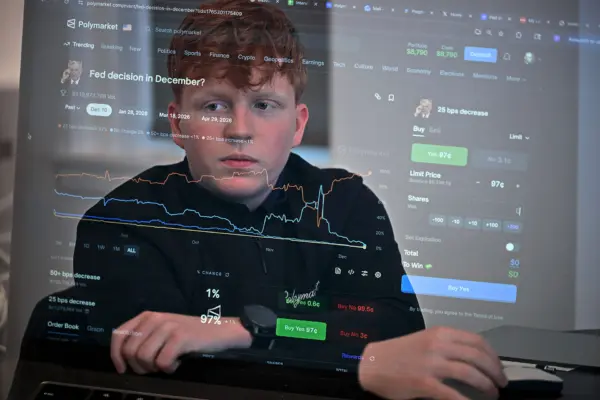
On a recent Tuesday afternoon, at a small, round table in a spacious apartment in Chicago’s Hyde Park neighborhood, 19-year-old Oliver Wilson sits engrossed in front of two laptop screens, neither of which have anything to do with his introductory-level molecular engineering final exam in a few hours.
The University of Chicago freshman is on Polymarket, watching in real-time as users bet whether interest rates will rise in the coming weeks. The cryptocurrency-based platform allows users to wager — through buying and selling contracts — on the outcomes of future events.
Users can make classic sports gambles and pick, for example, the future NBA champion. Or they can bet on the number of people President Donald Trump will deport in 2026. Or whether Jesus Christ will return by 2027. Or betting on whether U.S. military strikes would occur in Iran.
But it was the 2024 presidential election cycle that hooked Wilson, then a senior in high school.
“I was fascinated by the fact that these markets were able to more accurately, than any other poll, predict by what margin and where Trump would win,” he said.
Signing up for Polymarket that fall, Wilson bet on Trump winning, but his simultaneous speculation that Vice President Kamala Harris would win the popular vote ended up costing him about $50 overall.
A year later, the bad bet would be a footnote. Wilson came into a pledge for a lot more money, thanks to Polymarket. He spent a week as an intern at the company’s New York City headquarters this past summer and decided later to pitch Polymarket founder Shayne Coplan to seed a prediction market club on campus.
Over Instagram, Wilson sent Coplan a pitch deck and a brief outline of the club’s goals, and Coplan initially had a one word reply:
“Incredible.”
To start the club, he agreed to send Wilson and another student founder $20,000.
In a few years, prediction markets like Polymarket have gone from pariahs to poster children for all that is hot and trendy in the financial world. While states like Illinois call the markets illegal gambling, they have flourished with the full-throated support of Trump administration officials, who argue they have final say over regulating the markets — which often means little regulation at all. The Trump family has gone all in on prediction markets, with Donald Trump Jr. investing in Polymarket and is a “strategic advisor” to a competitor, Kalshi.
Coplan’s own future has turned from bearish to bullish in short order. He has gone from a man whose New York City apartment was raided by the FBI to being named last month to the Commodity Futures Trading Commission’s Innovation Advisory Committee.
And of course, kickstarting Wilson’s school club.
UPHILL BATTLE IN ILLINOIS?
The Trump administration has not only promoted prediction markets but vowed to fight state efforts to regulate them as they do online sportsbooks.
CFTC Chairman Mike Selig said in a statement last month that his agency “will no longer sit idly by while overzealous state governments undermine the agency’s exclusive jurisdiction over these markets by seeking to establish statewide prohibitions on these exciting products.”
“It’s clear that Americans like the product and want to participate,” wrote Selig, whose agency oversees commodities such as grain futures.
The federal move has left states like Illinois scrambling to stop an emerging industry that some observers predict could chip away at state-regulated sportsbooks like FanDuel and DraftKings.
States generally can’t tax prediction markets, losing millions, or regulate them, to protect their youngest and most vulnerable residents.
On-line sportsbooks businesses must pay millions of dollars in taxes to the state for each bet placed, forgo bets on in-state college teams, limit customers to those 21 and older, advertise help for gambling addiction and help pay for addicts’ treatment.
In Illinois, they pay a $20 million start-up fee and $1 million fee every four years to renew their licenses.
Prediction markets do none of that.
Neither do they have to follow strict truth-in-advertising regulations. During last year’s NBA finals, a Kalshi advertisement consisted entirely of AI characters, with a TV news correspondent asking a screaming woman holding a small dog in a storm how many hurricanes there will be this year, with an arrow pointing to a rising number in green with a dollar attached, indicating a profit.

Right now, no one knows how much Illinois and other states are losing in untaxed prediction market bets — the markets don’t have to report betting data to the states. Illinois has netted nearly $1.1 billion in tax revenue since Illinois’ first legal sports wagers were placed six years ago. States have sued to gain the power to tax and regulate prediction markets, but the markets argue their platforms are not gambling, but financial tools to allow users to hedge risk.
In one effort to rein in the platforms, State Sen. Michael Hastings (D-Frankfort) introduced legislation last week that would require prediction market operators to pay a $1 million fee to the Illinois Gaming Board to obtain a “master prediction market license” and empower the state to collect a tax equal to half of a licensee’s adjusted gross receipts from bets made by in-state users. The bill is awaiting to be assigned to a committee.
Experts believe the legal question won’t be settled until the U.S. Supreme Court weighs in. But by then, prediction markets may have become as integrated into American life as sports betting has in the eight years since the nation’s high court struck down a nationwide gambling ban.
DePaul University assistant law professor Karl Lockhart, who has studied prediction markets, said the conservative majority Supreme Court could decide either way on the matter. While the Trump administration has championed the industry, federal oversight of prediction markets would encroach on states’ rights, a traditionally conservative issue.
In any case, Lockhart said there needs to be a stronger regulatory framework.
“You have to have some sort of system of morality in place in a society otherwise, or your laws are just going to keep pushing things to the lowest common denominator and the lowest possible place,” he said.
WHAT ARE PREDICTION MARKETS?
Prediction markets are not new. Depending on whom you ask, they’ve been around for decades or even centuries.
The Iowa Electronic Markets, run by the University of Iowa’s business school, first allowed users in 1988 to bet on the presidential election between George H.W. Bush and Michael Dukakis.
In the early 1900s, people would go to Wall Street and bet hundreds of millions of dollars on presidential elections.
But in the past year, prediction markets have made the leap into mainstream culture thanks to aggressive marketing from companies like Kalshi and splashy bets featured on their websites on everything from congressional elections to the likelihood of when Taylor Swift and Travis Kelce will tie the knot.
Other markets generated national headlines but for the wrong reasons. Just last week, after the United States and Israeli missile strikes killed Iranian Supreme Leader Ayatollah Ali Khamenei, Polymarket canceled a market on whether there would be a nuclear detonation in 2026.
But the big money for prediction markets is sports wagering.
Even existing online sportsbook operations want a piece of the action, as they launch their own prediction markets to enjoy the benefits of what’s essentially regulation-free gambling in Illinois, the fifth-largest economy in the nation.
FanDuel, which operates the most lucrative sportsbook in Illinois, announced in December it partnered with CME Group, which operates the Chicago Mercantile Exchange, to launch its own nationwide prediction market.
Last month, the company announced that 100 million event contracts had been traded on the platform.
LEGAL PLAYING FIELD
Perhaps seeing the success that its competitors were enjoying in Illinois, the nation’s leading cryptocurrency exchange leapt into action at the end of the year and hedged its bet, with a carrot and a stick.
First, San Francisco-based Coinbase contributed $20,000 to political committees supporting Democrats in the Illinois House and Senate. Later that week, the firm sued Illinois Attorney General Kwame Raoul and other state gaming board officials seeking to stop the state from enforcing local gambling regulations against Coinbase.
The lawsuit brought to the forefront issues that the state had kept on the back burner since the Illinois Gaming Board sent out cease-and-desist letters to prediction markets such as Kalshi, Robinhood and Crypto.com in spring 2025, during the annual sports gambling gold rush spurred by the NCAA basketball tournament.
Earlier this year, the Illinois Gaming Board sent a letter to Polymarket, which does not yet offer a general platform in the United States. National customers have to use a virtual private network to obscure their Internet location to access the software hosted outside the country.
“No person or entity may engage in a sports wagering operation or activity in Illinois unless licensed by the IGB,” the letters said, threatening them with civil and criminal penalties.
Coinbase cited the Illinois letters in its lawsuit, which announced it was launching its own platform in January that would rely on the Kalshi exchange. Illinois’ ban on prediction markets “casts a cloud of uncertainty over the platform and threatens the company’s relationship with millions of customers and its affiliates,” which have facilitated “nearly $1 trillion in trading volume every year across multiple products.”
Coinbase has similar lawsuits against Connecticut and Michigan. Likewise, Kalshi is suing Maryland, New Jersey, Nevada, New York and Ohio.
The Illinois attorney general’s office declined to comment on the lawsuit. So far, it has taken a backseat to litigation, relying on other attorney general’s offices to take the fight to prediction markets.
“…We have seen similar situations in other nationwide litigation where a few lead states do the heavy lifting and the rest of the AGs pile on later,” said Kevin Frankel, a partner at the national firm Benesch Friedlander Coplan & Aronoff, who has written about the prediction market litigation. “Of course, a particularly activist state government could decide to grab the bull by the horns and attempt to create good case law in their district/circuit.”
The Massachusetts attorney general’s office has a reputation as a legal bulldog, and in September 2025, it sued Kalshi in state court. The lawsuit alleged the company had advertised itself on Instagram as “The First Nationwide Legal Sports Betting Platform” and skirted state laws similar to those in Illinois that prohibit people under 21 from sports gambling.
In late January, a state judge issued an injunction that banned Kalshi from offering sports betting in Massachusetts until the company follows the state’s gambling laws.
The lawsuit mentions that 139,600 Massachusetts residents “experience gambling problems” with “another 4 to 6 million … demonstrating problematic gambling behaviors” with Internet searches relating to “gambling addiction” spiking after sports gambling was legalized in the state. Kalshi facilitates gambling without any of the safeguards put in place to curtail gambling addition, the lawsuit states.
An Illinois study conducted during the COVID-19 pandemic showed about 3.8% of the adult population — or 383,000 people — are considered to have a gambling problem with another 761,000 people at risk for developing one. The real numbers might be higher because the survey was conducted during lock-downs and business closures and when online sports gambling had yet to be fully implemented, according to the study.
People who work in addiction recovery see little difference between gambling and prediction markets when it comes to their patients. All it takes to set up an account on one of the prediction markets is download the app and fund it through a debit card, a bank account or crypto.
“People can argue about whether it meets a legal definition, but from a practical perspective, and especially from an addiction perspective, it is categorically a type of gambling,” said Keith Whyte, the former executive director of the National Council for Problem Gambling.
“It can create a lot of the same excitement, and, of course, it can also create the same addiction as other forms of gambling. So a clinician, a psychologist, a counselor, a consumer and certainly, someone with a gambling problem sees prediction markets as indistinguishable from other forms of gambling.”
POKER AND OTHER PREDICTIONS
Wilson, the University of Chicago freshman, said he isn’t worried about becoming hooked because he doesn’t have an addictive personality. He became an avid prediction market user after first learning the finer points of a classic game of skill: poker.
A friend who used poker winnings to pay for his University of Chicago tuition introduced him to the card game two years ago at a holiday party. Wilson then bought David Sklansky’s “The Theory of Poker,” which he kept in his high school bookbag until the cover was worn.
“Every decision that you make inherently has probabilities tied to it, so making the most positive expected value decision is one of the most important things that you can discover within not just prediction markets, but also something like poker,” said Wilson, who counts Elon Musk among his heroes.
His campus prediction market club, Oracle Trading, is expanding. It now has a board with four members, an LLC for liability purposes, and has a goal of publishing one Polymarket-related data science article before the school year’s end.
Wilson said they’re getting the club its own bank account to facilitate the $20,000 contribution from Polymarket that Coplan, the Polymarket CEO, promised him in the Instagram message.
The donation is part of a larger promotional blitz that prediction markets are making on college campuses.
Wilson estimates that he makes up to 50 bets a week on Polymarket, though he says that many of the bets are “arbitrage,” meaning that he’s taking advantage of mispricings or differences in odds across platforms.
Wilson does see the potential for addiction in the same way a person can get addicted to sports betting, roulette or trading financial derivatives.
And what about the students joining his club?
“I think there’s a difference between just a risk taker and a gambler, and I think as long as those risks are exclusively calculated, then I am happy to let them in,” Wilson said.

This article first appeared on Capitol News Illinois and is republished here under a Creative Commons Attribution-NoDerivatives 4.0 International License.