
Evan Massey is a former Galesburg High School girls basketball coach who retired as one of the most successful coaches in Illinois history. He writes history features and a weekly Time Capsule column for WGIL.
GAA — Girls Sports As We Knew It
For parts of almost five decades, when people thought about girls sports in Illinois high schools, they thought of the Girls Athletic Association. Depending on the facilities of each school, it was a daily after-school program or just a program a few days per month.
Female athletes received instruction in different sports and had intramural contests in a variety of sports.
1929
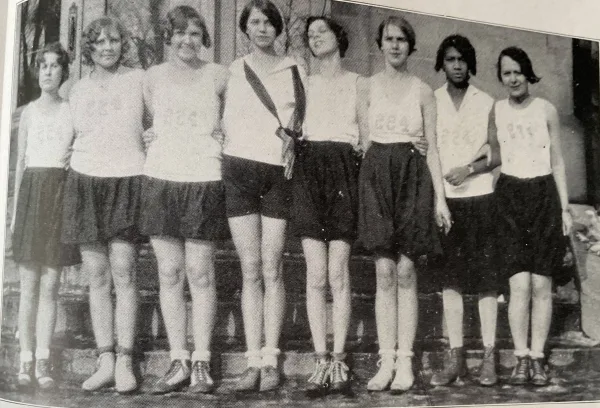
At Galesburg High School, female athletes participated in an all-school intramural basketball championship. The teams represented the home room of the players. This is the 1929 GHS Championship Team. Evans in the middle of the picture was my mother.

It should be noted that at GHS, girls did play interscholastic tennis in the 1930s and early 1940s. This was part of the old Northwest Conference.
1940
Galesburg High School offered programs in volleyball, basketball, track, aerial darts, ping-pong, swimming, social dancing, and diving.
The GHS Reflector (yearbook) says that the GAA had a membership of over 100 students.


1947
GAA had become so organized that not only did it have officers, but it had a cabinet. Each of the cabinet members was the chairman of a particular sport.
The GAA sports included volleyball, aerial darts, badminton, ping-pong, swimming, bowling, speedball, basketball, tennis, archery, and softball.
The organization ran the “Copper Carnival” as a fundraiser, where students paid a penny for different things. The carnival included a kissing booth, fortune teller, fish pond, cake walk, water show, and variety show.
By this time, on a statewide basis, they had developed “Play Days.” Athletes from different schools would go to one location and play a variety of sports during the day. Galesburg hosted a Play Day with Monmouth, Alexis, Aledo, and Williamsfield. Athletes were divided up so that there were athletes from different schools on the teams. They were not allowed to compete with one school vs. another school.


1956
By 1956, the GHS Reflector identified the GAA as one of the biggest and most active clubs in the school. Interest was so great and so varied that GHS divided the GAA program into three parts:
Orchesis — dance
Penguin Club — swimming
Sports Division — traditional GAA sports


1970
Female athletes earned points by participating in activities. The points were required to earn membership and to earn State Awards. At the end of the year, the GAA held a “Mother-Daughter Picnic,” at which time the athletes were presented their awards and the officers for the next year were introduced.

1972
Galesburg’s GAA included archery, soccer, field hockey, volleyball, basketball, badminton, bowling, ping-pong, and roller skating.

1972 — IHSA Postal Competition
The IHSA ran “postal competition” in sports like swimming, bowling, archery, and basketball shooting.


1972-1973 — Play Days & Game Days
The IHSA allowed GAA members from different schools to go to another school for “Play Days,” where they intermixed and played a variety of sports.
The IHSA began to establish “Game Days” — on selected dates, schools could go and play another school in selected sports. In 1972-73, girls basketball was limited to four Game Days.

October 1973 — Warning About Interscholastic Sports
At the GAA conference of leaders, Dr. Robert Elliott spoke on the impact that interscholastic sports might have on the GAA. Elliott was the principal at Glenbard West. His concern was whether schools would continue to invest in intramural programs that had reached so many female students.


Follow Evan Massey:
Blog: masseybasketball.blogspot.com
Twitter: x.com/MasseyBball
Facebook: facebook.com/MasseyBball