

Evan Massey is a regular contributor to WGIL. He is the former girls basketball coach at Galesburg High School, retired as one of the most successful coaches in Illinois history. He writes history features and a weekly Time Capsule column for WGIL.
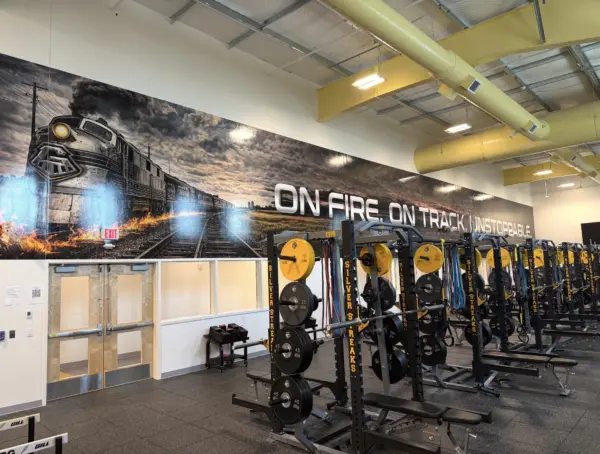
Anyone who has gone by Wicall Gym just East of GHS may be surprised to see the new addition. The complex includes a wrestling room so the wrestlers don’t use the tiny balconies anymore, an indoor area designed for both softball and baseball indoor workouts, and a weight room with increased space.
I asked the P.E. Department Chair, Jim Noonan if I could come over and watch one of his classes in the new weight room. I was so impressed by what is going on.

16 Stations
When I went in the doors, I was struck by the space and the organization of equipment. There are 16 stations where three students are each assigned to each station. They do not ever have to rotate, they can do everything in their individual program at their assigned station.
The class that I attended had 40 students. There was no sense that the room was crowded. Each station is equipped to allow them to do traditional weight training exercises such as bench press, incline press, squats, and more. Each station has a set of barbells, a set of dumbbells, elastic bands, and an iPad.
I asked Coach Noonan how many different exercises can they do at their station. When he hesitated, I suggested 20-25 exercises per station. He laughed and said, “Probably more like 100-150 different exercises.”
Coach Noonan’s Thoughts: “One of the periods, Andrea Sampson and I each have a class in there at the same time. With the setup of this weight room, even though there’s 48 kids, it’s really not that crowded. It doesn’t feel crowded because we are able to spread them out into three students per station. We have students who have never played a sport in there, and all-conference athletes. It actually works out extremely well.”

Not just for athletes
The weight room is not just for athletes. During the day, they have 5 classes of Sports Training classes designed for athletes, and 3 classes of Weight Training for students who want to work to develop their strength and fitness.
On the day that I observed, there were over 300 GHS students working out in the weight room. They ranged from 220 pound male football players to 100 pound female tennis players to 130 pound non-athletes who had never lifted before this year.
Coach Noonan’s Thoughts: “With the Weight Training class, Coach Sampson has a workout for them. They’re in weight 3 days a week, and then they spend the other 2 days doing other fitness exercises. But every kid has a program that’s in the iPad and everything’s being tracked.”

Trained professional in charge
Coach Noonan is in charge of the program. He has a BA in Exercise Science, Masters in Sports Management, and is a NHSCCA Certified Strength Coach. As part of his training, Noonan did a strength and conditioning internship with the New York Yankees.
He has designed the programs that are used by the students. It is impressive that he seeks out feedback from other coaches and from the athletes themselves.
Several times in our conversation, Noonan mentioned an idea that Coach Jacob Carl from the football program had given to improve the strength program.
There are a set of track hurdles at one end of the room in an open space. When I asked about the hurdles, Noonan said, “Brad Gross (track coach) felt a lot of the runners were not doing enough to improve their hip mobility.” The result, Noonan put together a series of simple exercises the students use to improve their hip mobility.

Buy in from students and coaches
Any adult who has tried to maintain their weight knows that a one month diet doesn’t do the trick. To be successful, you have to continue managing your diet.
The same is true with strength training, you can’t just lift for a short time and expect to retain your strength. To become fit and strong both athletes and non-athletes need to continue lifting year round.
It used to be at GHS in athletics, many athletes and some coaches felt they did not want to lift when they were “in-season athletes.” They wanted to stay fresh for their contests. The problem with this philosophy is that many GHS athletes are multi-sport athletes. So if athletes either didn’t lift or lifted light “in-season” and they were out for 2-3 sports, they were really never lifting and getting stronger.
The program of the PE Department has encouraged both coaches and athletes not to view an athlete as a “football player,” “volleyball player,” or a “baseball player.” Instead they have created a culture where they view themselves as simply an “athlete.”
It is obvious that the students have bought into the idea of using the weight room to become more athletic. This approach is true for the students who play sports and for the students who do not play sports.
On the day of contests, the students lift. Their lifting may be adjusted to have fewer reps but to be explosive and actually activate their system.
Coach Noonan’s Thoughts: “My question has always been, if a 3 sport athlete is just maintaining during a season, when is that 3 sport athlete actually trying to improve their strength and improve their ability to produce power. Just lifting for a couple months in the summer is not enough. Our approach now allows us to have the kids continue to try to work, continue to try to make small gains during the season. As we get towards the end of the season, we go into a little bit of a taper, get them ready to be at their peak performance.”
“Last year if I would have told kids, ‘It’s game day, but you need to lift today.’ Last year I would have got a lot more pushback on that than I would get this year. Being an assistant coach for girls basketball, I was able to use them as an example of continuing to lift in-season and to lift the day of a game. Everyone was able to go out and compete and do well. So the mentality has changed.”
“We’re pretty smart about what we do on game day. We do lower the volume. The last thing we try to do is fatigue anybody. If at all possible on a game day, what we’re trying to do is to stimulate the central nervous system a little bit and get them doing some explosive things. We just make sure that they’re doing extremely low volume and that they’re really just trying to wake up the nervous system.”
“Studies show doing that kind of stuff at some point during the day that you compete, is proven to kind of help you go out and compete a little bit better, jump a little higher, a little faster. So this year the kids have been buying into it and they’ve been going out and they’ve been feeling good when they compete.”

‘Good morning, here is today’s workout plan’
Coach Noonan uses a weight training app for the classes. To start, he sets up a core program for all the athletes. Then he is able to go into the program and adjust it for a variety of factors: whether they are in-season, out-of-season, or not involved with sports; what sports they are trying to prepare to play; what their competitive schedule looks like; and whether they are battling a nagging injury.
Each morning each of the students receives an email informing them what their workout plan for the day will be. It spells out each exercise, the number of reps of each, and the suggested amount of weight they will use.
Coach Noonan Thoughts: “The iPads are just incredible. I’ve got to thank every administrator, both at the Board Office and the Galesburg High School, who played a role in that because it’s really been a life-changing switch for us in the weight room.”
“Let’s say you’re having some soreness in your knee when you’re squatting. I could go in right now and make an adjustment on the iPad to that student’s workout plan.”

Students on a mission
I was totally impressed how quickly the students got to work when they arrived to the weight room. At no point did Coach Noonan have to say to any of the students, “Time to get to work,” or later to say, “Quit messing around and get to work.”
The students arrived and immediately went to their assigned stations, and because they had received the morning email they didn’t have to spend time figuring out what to do.
The first student at each station picked up their station’s iPad and got their information organized, and then started lifting. Usually at each station, one student was recording their results on the iPad, one student was lifting, and another student was spotting them for safety. To say they were a well oiled machine would be an understatement.

Motivation
Getting even the most motivated athlete to be excited about lifting is not always easy. The reward for the hard work is off in the distance. The workout itself can be repetitious, hard work, and boring. Students are not going to get positive reinforcement for months.
While they all do basic, core lifting exercises, boredom is alleviated by the ability to assign literally hundreds of additional exercises. The day I visited, students were doing old fashioned chin ups with weights hanging from their waist, working with a weighted ball, doing flexibility exercises, and using an elastic band to bound up and down. Later a couple students went through the garage door out onto the patio and did exercises with large tractor tires.
On the iPad, the students record their results. On the core exercises, the program calculates, based on that day’s performance, what the student’s max amount for one rep on that exercise would be. The student can quickly tap on the screen and it will show the student a chart of their history on this particular exercise. They don’t have to wait for several months to see their progress.
When the student records their workout, if they set a personal record for that exercise, the program will immediately indicate that to the student and send a message to Coach Noonan. The student goes to the front of the weight room and picks up an air horn and sounds it for all to hear. Those who are not lifting at the time, immediately applaud and usually give a cheer to that student.
Noonan is exploring replacing the air horn with a train whistle.
On the wide screen TV, it was constantly rotating charts. The charts would show rankings for different exercises in the class and for the school.
It also flashed up a ranking of strength based on the individual’s body weight. So the 100 pound tennis player might find on certain exercises that they were actually performing better than the 220 pound football player.
Coach Noonan’s Thoughts: “I have had kids tell me, ‘I feel better when I lift.'”

More than weights
As part of the program, Coach Noonan has a series of sports psychology lessons the students work on certain days. These lessons look at handling stress, setting goals, visualization, leadership, and peak performance.
Andrea Sampson, who teaches the Weight Training portion of the class, has brought concepts of relaxation training and meditation to the classes.


Follow Evan Massey:
Blog: masseybasketball.blogspot.com
Twitter: @MasseyBball
Facebook: facebook.com/MasseyBball